
Lately, we’ve been hearing the same thing across San Antonio-area manufacturing facilities:
“Turnover is killing us.”
With manufacturing continuing to grow across San Antonio and Central Texas, many HR leaders are seeing the same retention challenges appear across production floors.
So in this blog, we’re focusing on the most common causes of employee turnover in manufacturing — and what HR leaders can realistically influence to improve employee retention.
1. Shift Fatigue Can Affect Your Team More Than You Realize
Long hours aren’t new to manufacturing. If anything, they’re unavoidable.
The real problem often starts with unpredictable schedules.
Research published by the National Institutes of Health (NIH) shows that rotating and irregular shifts are strongly associated with higher burnout and job dissatisfaction.
Rotating between morning and night shifts creates inconsistent sleep and rest schedules. When employees can’t plan their lives — or their sleep — outside of work, they eventually start planning their exit.
What can HR control?
-
- Structure shift rotations around days worked rather than switching between day and night shifts. Keeping employees consistently on the same shift helps reduce fatigue and improve retention.
- Be transparent about overtime expectations during the hiring process. Clear expectations help prevent early frustration.
- Communicate production forecasts clearly. If work volume is expected to increase, a simple heads-up helps employees prepare for possible overtime.
Remember, stability builds retention.
2. Great Frontline Supervisors Drive Retention
Here’s something we’ve all heard before: Employees don’t leave jobs – They leave managers.
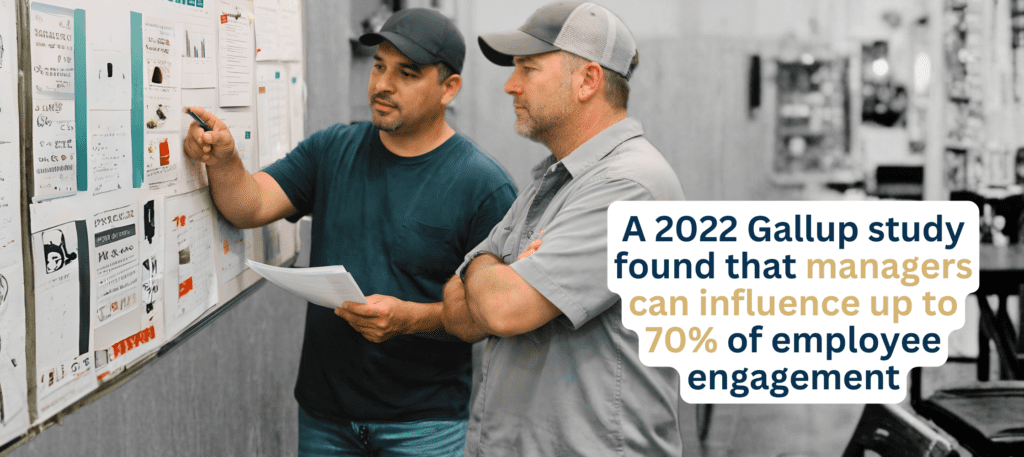
A 2022 Gallup study found that managers can influence up to 70% of employee engagement, and low engagement is directly linked to higher turnover.
Manufacturing facilities often promote employees into leadership roles based on production output and technical ability. But strong technical skills don’t automatically translate into strong people skills.
Without proper leadership development, communication gaps grow and employee engagement suffers.
What can HR control?
-
- Provide frontline leadership training that focuses on communication and team management skills.
- Implement 30/60/90-day feedback check-ins for newly promoted supervisors.
- Define clear communication expectations for leaders across the production floor.
Strong supervisors build stronger teams — and stronger retention.
3. Speed-to-Hire Can Lead to Early Turnover
Hiring in a rush often leads to people leaving in a rush.
When production falls behind schedule, hiring pressure increases.
Interviews get shorter.
Hiring standards soften.
Employment history gets overlooked.
According to the Society for Human Resource Management (SHRM), poor job fit is one of the leading causes of early-stage turnover, especially within the first 90 days.
What can HR control?
-
- Include job walkthroughs during the hiring process. Showing candidates the real work environment helps ensure alignment.
- Clearly explain production pace and physical demands. Transparency improves long-term fit.
- Review employment patterns carefully. Candidates with stable work histories often bring stronger long-term retention than those simply available to start immediately.
Fast hiring fills a shift.
Aligned hiring builds stability.
4. Lack of Clear Advancement Paths Is Pushing Employees Elsewhere
The modern production workforce wants mobility. Not necessarily management, but growth and opportunity.
A 2023 Deloitte Manufacturing Industry Outlook report notes that career development and upskilling opportunities are increasingly critical to retaining skilled manufacturing workers.
When employees can’t see growth opportunities within a company, they assume there aren’t any — and assumptions often lead to turnover.
What can HR control?
-
- Create defined leadership ladders that show employees potential career paths.
- Promote cross-training programs for employees who want to expand their skills.
- Document advancement criteria clearly. When employees understand how to grow, engagement improves.
Turnover Isn’t Random — But It Is Controllable.
Retention isn’t always about perks or pay rates.
It’s about consistency, transparency, and a strong leadership.
Great hiring starts with proactive, clear communication. If turnover or a shortage of qualified applicants is starting to take too much of your time, give FirstOption Workforce Solutions a call!
Let’s talk about what smarter hiring looks like for you! Call us at (210)733-3700!